






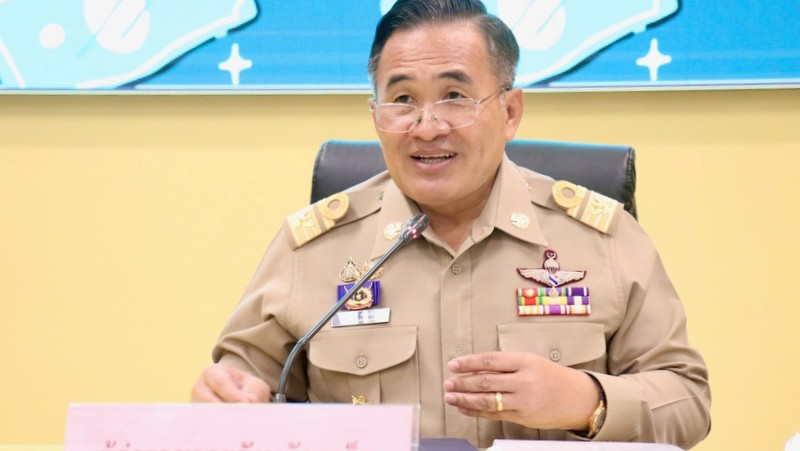
Although the Cabinet approved the transfer on Oct 14, the move cannot take effect until His Majesty the King signs the royal appointment order.
“There is still no royal order or approval from His Majesty the King,” Anuphong Panarat, Secretary to the Phuket Governor, told The Phuket News. “Until the royal approval is received, no transfers will take place.”
“I think it is normal to wait for a while,” he added. “But I don’t know why it is taking this long.”
He confirmed that following the passing of Her Majesty the Queen Mother, no date or timeframe could yet be set for when the royal endorsement might occur.
Governor Saransak, who took up office as Phuket Governor on October 1, is to relieve himself of his duties here and assume the governorship of Nong Khai once the royal order is issued.
Speaking with The Phuket News, Governor Saransak said he is content to remain in his post for now. “I am happy working here. It is fun to work with the people of Phuket ‒ and especially challenging,” he said. “I feel sad that I have had too little time in this position.”
Governor Saransak officially began his term as Governor of Phuket on Oct 1. His latest transfer, approved less than two weeks later, if actually effected would have made him the shortest-serving Phuket Governor on record.
Despite the uncertain timeline, those close to the governor have praised his professionalism and dedication.
“Our Phuket Governor is a hard-working person,” Mr Anuphong said. “Looking at his past experience in administration, he has progressed steadily from District Chief to Deputy Director-General, a Ministry Inspector-General and now Governor of Phuket. He is generally well-rounded.”
However, Phuket MP Chalermpong Saengdee, who has been outspoken on the issue of frequent transfers of provincial governors, reiterated his call for reform of Thailand’s centralised administrative system.
“This system continues to show how little power local people have over their own governance,” MP Chalermpong told The Phuket News. “If governors were directly elected by residents, they could truly represent and respond to the province’s needs.”
He said the repeated reshuffling of centrally appointed governors reflects a deeper structural problem ‒ the lack of true decentralisation.
“Thailand has been trying to decentralise power for decades, but real power still lies with the central government,” he said. “Local governments have only meagre authority and remain unable to truly develop their provinces or the country.”
MP Chalermpong has long advocated for direct elections of provincial governors, arguing that such a system would lead to more stable and effective local governance.
Under Thailand’s current structure, provincial governors are appointed by the Ministry of Interior and serve as the top decision-makers in each province, while local administrative bodies such as Provincial Administrative Organisations (PAO), Subdistrict Administrative Organisations (OrBorTor) and municipalities remain subordinate to them.
Until the royal approval is received, Governor Saransak will continue to serve as Phuket’s top provincial executive ‒ for however long that may last.