






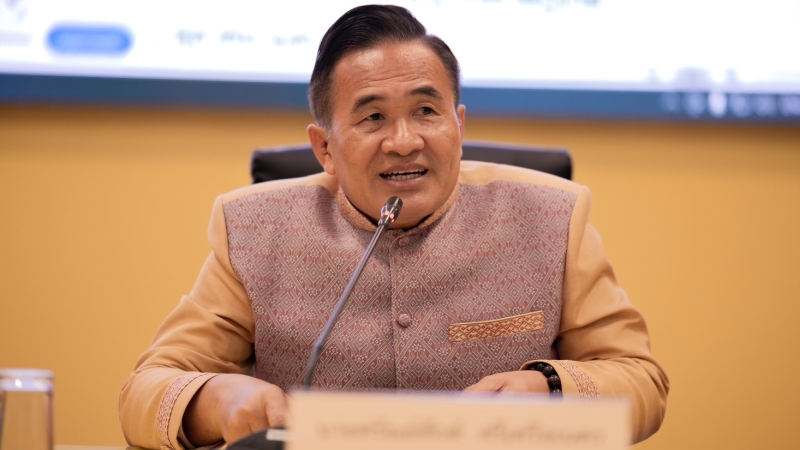
Governor Saransak, who was officially dubbed Phuket Governor from Oct 1. He arrived in Phuket on Oct 2 to begin his term. His transfer makes him the shortest-serving Phuket Governor on record.
Anuphong Panarat, Secretary to the Phuket Governor, confirmed to The Phuket News that the transfer was official.
However, he added, "This is just the latest Cabinet resolution… It will become effective only upon Royal Assent." Regardless, transfers approved by Cabinet historically have been swift.
Mr Anuphong’s confirmation follows documents marked ‘confidential’ being leaked online earlier today.
Governor Saransak is to be replaced by Nirat Pongsittithaworn, who as of today has been relieved of his position as Director-General of the Department of Provincial Administration (DOPA).
Of note, Mr Nirat became Director-General of DOPA under the short-lived administration of Phumtham Wechayachai, who served as Acting Prime Minister for just 66 days, from July 3, 2025 to Sept 7, 2025.
Mr Nirat’s series of fast-tracked promotions have all come while Anutin Charnvirakul has served as Minister of Interior.
Anutin, leader of the Bhumjaithai Party, is currently Prime Minister of Thailand under an agreement with the People’s Party ‒ on the condition that he holds a national general election within four months.
Despite the well-publicised agreement with the People’s Party, many political pundits have already made public their concerns that Anutin is already preparing to hold onto power for much longer.
Originally from Bangkok, Mr Nirat has previously served as Governor of Chiang Mai. His experience as a provincial governor first started with the very rural Bueng Kan Province, then in Udon Thani. He was then transferred to the DOPA headquarters in Bangkok.
Widely respected Phuket MP Chalermpong Saengdee has already posted online his observations regarding the imminent transfer of Governor Saransak, and the regular reshuffling of provincial governors.
“The [latest] Phuket case may be special, but this phenomenon has long been a normal cycle in Thai government administration,” he said. “Most governors serve only one to four years, and often they are senior officials nearing retirement. Once they begin to understand the local context, they are transferred again.”
“It’s not the fault of the individual governor, but of the system itself,” he wrote. “How can such a system effectively develop the people’s hometown province?”
Under Thailand’s current structure, provincial governors are appointed by the Ministry of the Interior and serve as the top decision-makers in each province, MP Chalermpong explained.
Although local bodies such as Provincial Administrative Organisations (PAO), Subdistrict Administrative Organizations (OrBorTor), and municipalities exist, they remain subordinate to the governor in most key decisions, he noted.
“When it comes to major issues, local governments can’t act on their own… The governor must either sign off or send the matter to the central government for approval.”
MP Chalermpong described the system as “the most inefficient form of government administration”, where power rests almost entirely with centrally appointed officials who often have limited understanding of local needs.
He also lamented that despite the 1997 Constitution’s intent to promote decentralisation, progress has stalled.
“Thailand has been trying to decentralise power for decades, but real power still lies with the central government,” he said. “Local governments have only meagre authority and remain unable to truly develop their provinces or the country.”
MP Chalermpong concluded by calling for the direct election of provincial governors by local residents.
“This phenomenon underscores the ineffectiveness of the current administrative system and further emphasises the need for direct elections of provincial executives from actual provincial residents,” he said, ending with the hashtag #ElectGovernors