






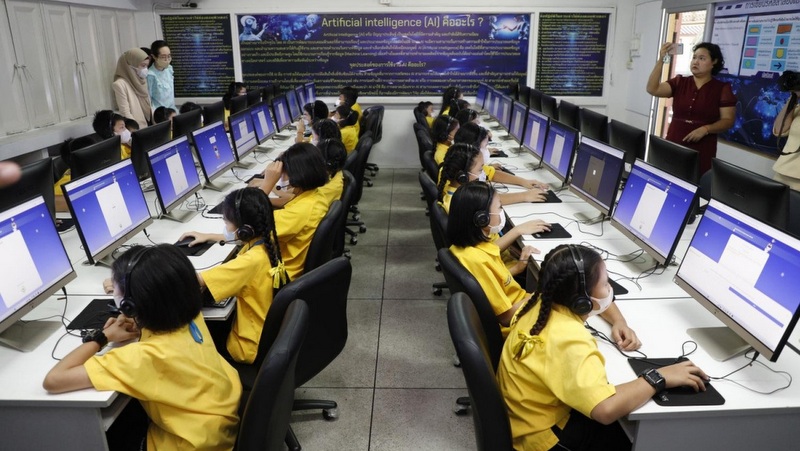
Children are being tested on their ability to memorise facts, sit through standardised exams that rewards compliance over creativity and are expected to emerge successfully into a world that demands agility, emotional intelligence and technological fluency.
The disconnect has become almost impossible to ignore. While artificial intelligence is reshaping every industry, education remains stubbornly analog, clinging to models designed a century ago to produce factory workers, not creators, innovators, or system thinkers.
The great mismatch
The core problem isn’t laziness or lack of innovation – it’s inertia. Most education systems, from the British A-Levels to the International Baccalaureate (IB) are built on a similar foundation: students are graded on how much they remember, not how effectively they think; curriculums are divided into subjects that barely interact, though the real world is inherently interdisciplinary; and teachers are being burdened to deliver static syllabi while technology evolves faster than any textbook can be printed.
It’s not that schools are doing their jobs badly – it’s that they’re doing the wrong job very well.
Teachers can’t be faulted as the system refuses to let their role evolve. The truth is, most teachers want to innovate, to personalise learning, to help students think critically and creatively – but they’re bound by policies, outdated metrics and institutional inertia that chained them to the past. To unlock education’s future, we must first liberate its teachers and give them the autonomy, tools and trust to evolve into mentors, facilitators and co-learners today’s world demands.
Customised education
In 1984, Benjamin Bloom wrote a groundbreaking insight that nearly all learners can achieve mastery when instruction is adapted to their individual pace and needs. Instead of teaching to the “average”, Bloom argued for mastery learning. Each student only moves forward when they have demonstrated a deep understanding of a concept. His work showed that students who tutored one-on-one outperformed students in a traditional setting by two standard deviations. Today, with AI adaptive technology, Bloom’s vision of customised education is finally scalable. Systems can be designed to continuously assess each learner’s progress, identify gaps, and adjust content and feedback in real time.
The curriculum of the future
If schools are ready to adapt to the current world system, they must begin by breaking down the three-sacred cows: exams, subject silo, and teacher-as-oracle model.
1. Assessment should be continuous, not catastrophic: exams currently measure how students perform under pressure, not how deeply they understand or how they learn. In an AI-driven world, the process matters more than the product. Schools should evaluate students through portfolios, projects and real world problem solving.
2. Subjects should merge into systems: Climate change isn’t a ‘science problem.’ Poverty isn’t a ‘social studies problem.’ The next generation must learn to see across boundaries and understand how data, design, ethics and governance interlock.
3. Teachers are not deliverers, they evolve into coaches: Teachers aren’t the main source of knowledge but rather work to motivate and inspire students to follow their own path and unlock their ikigai. Their role shifts to become architect of a learning environment where they use AI to personalise learning and free up time for deeper mentorship.
Moment of truth
Picture a classroom that functions more like a start-up incubator than a lecture hall. Students collaborate in small teams in mixed aged settings on real challenges – building AI models to track local pollution, creating digital art exhibitions that tell social stories, or coding chatbots that teach history through conversation. Every few weeks, they present their projects to peers, teachers and community mentors for feedback. Their grades aren’t numbers but narratives of growth backed by evidence in portfolios.
The world won’t wait for Thailand’s education system to catch up. AI will keep advancing. The economy will keep transforming. And the question is whether we want our children to be consumers of technology or creators of the future. This transformation isn’t a luxury; it’s a survival strategy.
Parents often worry that AI will “take over” their children’s minds and that it will replace thinking, creativity, or even human connection. But the truth is that it isn’t here to consume your child’s potential, it’s here to expand it. Used wisely, AI can enable our children to guide it, question it, and use it to build a smarter and kinder world.