






In the 2022 Programme for International Student Assessment (PISA) conducted by the Organisation for Economic Co-operation and Development (OECD) to test the reading literacy, mathematics, and science skills of 15-year-olds in over 65 countries, students in Thailand scored less than the OECD average, reports the Bangkok Post.
The national results, also lower than those from the last assessment in 2018, underscored weaknesses in the education system and the urgent need for new, technology-driven learning models, critics said.
The next four years will be critical, authorities say, as Thailand prepares for the generation born in 2025, who are expected to grow up with AI-supported learning from an early age.
The Bureau of Academic Affairs and Educational Standards (BAAES), under the Office of the Basic Education Commission (Obec), is leading the effort to bring AI into classrooms nationwide.
Bangkok in pole position
Bangkok deputy governor Sanon Wangsrangboon said schools under the Bangkok Metropolitan Administration (BMA) have been transforming digitally for more than three years.
Speaking to the Bangkok Post recently, Mr Sanon said the work requires not just funding but clear policies on responsible technology use and long-term planning.
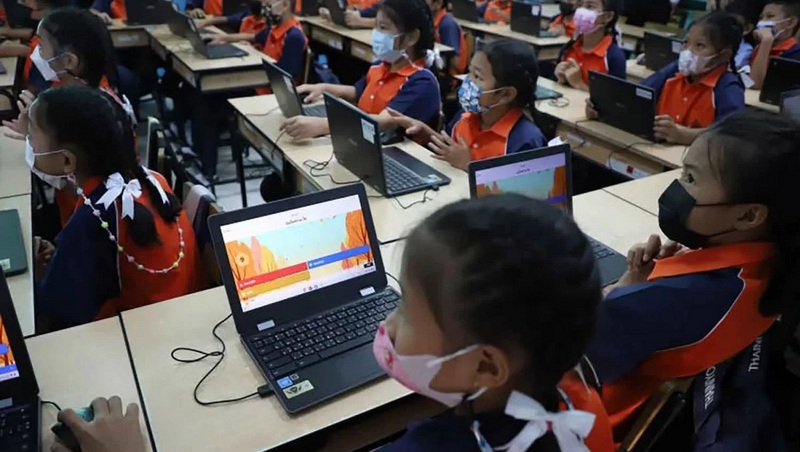
By the end of this year, he said, every Prathom 6 (Grade 4) student across 437 BMA schools will have access to their own computer for the first time.
He said pilot projects in six schools using AI-powered learning showed a marked improvement in student engagement, with many of the students arriving at the school early and staying late to continue lessons.
To improve English proficiency, seen as essential for global competitiveness, the BMA has launched a citywide strategy combining technology, teacher training, and student development.
In partnership with education startup Edsy and SVOA Public Co Ltd, the BMA introduced Edsy AI Coach, an intelligent platform that helps students practice English pronunciation and grammar.
“Hiring native English teachers is costly and not always possible,” Mr Sanon said, adding that AI helps enable personalised learning in large classes.
Last year’s report from pilot schools found that students improved fluency by 10%, language accuracy by 14%, and pronunciation by 12% within two months, he said.
Encouraged by the results, the project has now been expanded to 136 schools in its first phase and will soon cover all BMA schools.
Smarter learning
At the national level, BAAES has developed AI-based teaching materials and handbooks for teachers and students.
More than 60,000 students and 700 pilot schools have taken part in training programmes, helping build early AI literacy among young learners. “Teaching with AI reduces teacher workload and personalises instruction,” said Eakasit Piyasangtong, director of BAAES.
“We’ve partnered with Google, Microsoft, and other global organisations to use tools such as Gemini, Chattivity, Deepseek, and Leonardo. More than two million educators have already participated in AI-related training.”
The Electronic Transactions Development Agency (ETDA) is also promoting digital ethics through its Digital Citizen Plus curriculum. The programme helps teachers develop “digital intelligence”, ensuring that students learn to use technology safely, responsibly, and creatively.
Globally, 97% of students are exposed to AI in some form, but more than half pursue AI learning independently. Mr Eakasit said Thailand’s strategy aims to close this gap through structured classroom programmes and comprehensive teacher training.
The World Bank has observed that Thailand’s investment in innovation and future skills remains lower than that of countries like South Korea or Vietnam. “Thailand has begun moving toward innovation and creativity, even developing its own innovation index - one of the few countries to do so,” said Melinda Good, the World Bank’s Division Director for Thailand and Myanmar.
“But greater investment in innovation and education beyond the basics is essential,” she said.
Mr Eakasit noted that Thailand’s cultural diversity and creative traditions give it an edge in developing AI learning models suited to local needs. “AI can support not only STEM education but also arts and problem-solving,” he said. “Students can combine technology with traditional skills to create original, high-quality work.”
AI learning now begins as early as kindergarten and continues through secondary school, teaching students to use AI tools, recognise their influence, and think critically about ethical implications.
With nearly 60,000 students and 700 schools already engaged, Thailand’s foundation in AI literacy is growing steadily. The next phase, Mr Eakasit said, will focus on building a full AI ecosystem, from access to devices and local data centres to research hubs and ethics education.
“Thailand’s long-term goal,” he concluded, “is to move beyond being an AI consumer and become an AI innovator”.