






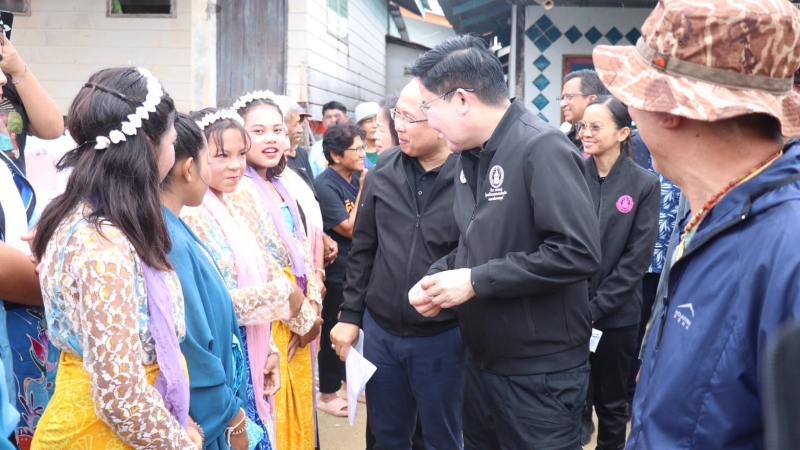


Phuket Governor Nirat Phongsitthaworn officially welcomed the delegation.
Mr Akkhara said successive governments have recognised the importance of safeguarding Chao Lay traditions, referring to the 2010 Cabinet resolution designating special cultural areas and Article 70 of the 2017 Constitution, which obliges the state to protect ethnic groups and ensure they can live according to their customs.
“I want to be another driving force in ensuring that we all have 100% access to our rights,” he said, adding that he left a written message on a map displayed at the event to symbolise his commitment to working with the community.
Key longstanding issues highlighted include the absence of formal housing titles despite generations of residence, overlapping or disputed land deeds, and encroachment on sacred sites and cemeteries. Marine-use areas have also been reduced to just two zones due to conservation and tourism designations, affecting traditional livelihoods.
Limited education access, declining cultural and linguistic support, and reduced opportunities for young people have heightened fears about loss of identity. More than 400 Chao Lay remain stateless, particularly in the Surin Islands and the Ranong archipelago.
Historically, the groups used more than 24 islands, but many were later restricted by development and conservation policies, making healthcare and social welfare increasingly difficult to access.
Mr Akkhara said the Ministry is moving forward under the new Ethnic Groups Protection and Promotion Act of 2025 to expand welfare access under the ‘MSD Near You’ policy, targeting newborns, the elderly, people with disabilities, and other vulnerable groups in remote ethnic communities.
As an urgent initiative, the Ministry will ensure access to state welfare for at least 480,000 stateless people in the process of restoring nationality status, even while legal procedures are still underway. Secondary legislation for the new Act is currently being drafted.
Thailand is home to at least 60 ethnic groups with a combined population of around six million.
Mr Akkhara said sea gypsy communities ‒ present along the Andaman coast for more than three centuries ‒ now number 14,367 people across 46 communities in Phuket, Phang Nga, Satun, Ranong and Krabi. They include the Moken, Moklen and Urak Lawoi groups.
During the visit, the Minister also witnessed the signing of a Memorandum of Understanding to ‘Promote and Protect the Way of Life of the Sea Gypsies of Laem Tukkae’.
Nineteen agencies and network partners took part, including Phuket Province, the Provincial Social Development and Human Security Office, the Provincial Culture Office, the Provincial Public Health Office, the Provincial Education Office, the Fisheries Office, the Agriculture and Cooperatives Office, the Community Organization Development Institute, the Princess Maha Chakri Sirindhorn Anthropology Centre, P-Move, the Thai Community Foundation, the Andaman Sea Gypsies Network, and the Laem Tuk Kae Community.