







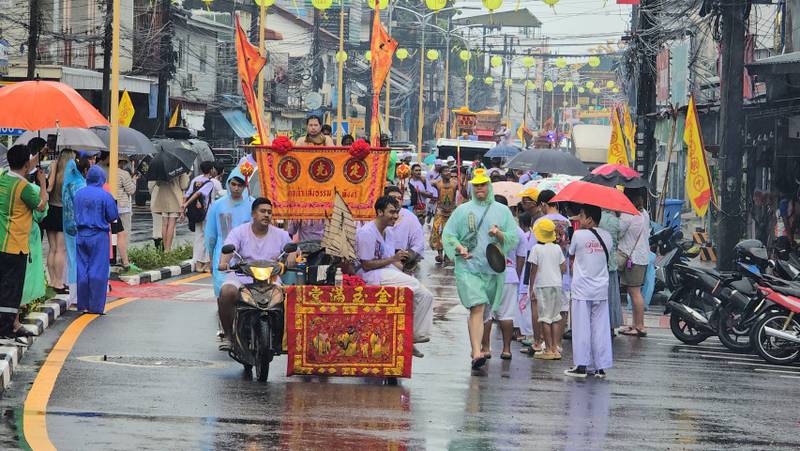

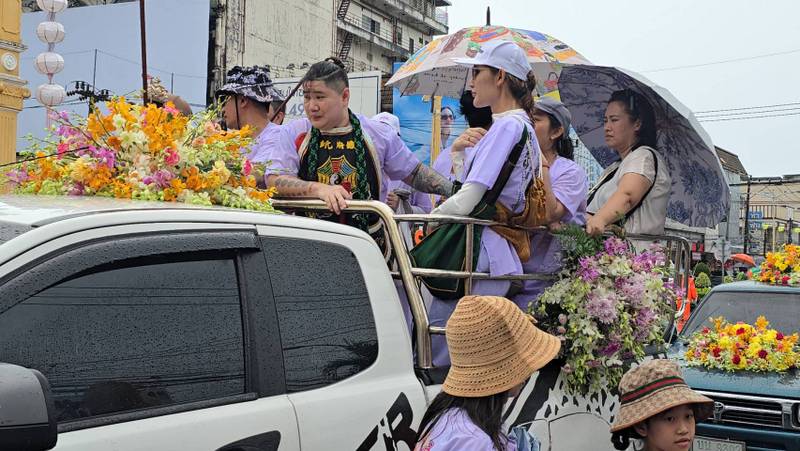


“The festival began as gratitude, not entertainment,” Prasert Khaokitpaisan, President of Kathu Shrine, who has also served previously as Mayor of Kathu, told The Phuket News.
“People saw their prayers answered. They made a vow to continue the tradition, and that vow has lasted 200 years. However, In the past 20 or 30 years, the elements used by spirit mediums (‘mah song’) have become more and more extreme.
“Tourists expect something extreme, so some mediums push beyond what our ancestors intended. But this is not the true spirit of the Vegetarian Festival,” he added.
Mr Prasert said that a concerted push for the 200th anniversary this year is a campaign to highlight the spiritual aspects of the festival, namely through a series of events branded ‘Sattha’, the Thai word for ‘Faith’.
“If we lose the purity, we lose the heart of the festival,” Mr Prasert warned. “Our ancestors began this to heal the people of Phuket. Two centuries later, that purpose must remain.”
THE FESTIVAL
Each year during the ninth lunar month of the Chinese calendar, devotees across Phuket commit to a strict vegetarian diet and the ‘Five Precepts’, which includes abstaining from meat, alcohol, sex and worldly pleasures. The period of abstinence has one holistic goal ‒ to purify both body and soul.
Spirit mediums, or Mah Song, pierce their bodies with swords, spears, or needles while entering a trance believed to be possession by Chinese deities.
These rituals, once rare and deeply personal acts of devotion, have gradually turned into public performances. Crowds line the streets for processions, and social media is flooded with close-up photos of pierced cheeks and firecracker explosions.
The traditional elements used by mah song include blessed swords and skewers, but over the years irregular items borne as face piercings have included handguns, motorbike parts, beach umbrellas and even dispensers from petrol pumps.
Mr Prasert said the Kathu Shrine has maintained strict rules limiting the tools used in rituals ‒ only swords, knives, or needles no more than an arm’s length are permitted.
“We never allow anything else,” he said. “When the spirits descend, the mediums lose awareness of their surroundings. Using dangerous objects is not only disrespectful ‒ it tortures the human body that carries the spirit.”
He emphasised that the true meaning of the festival lies not in endurance or shock value, but in faith to relieve pain for people who follow and believe in the traditions.
“Eating vegetarian is about cleansing the mind and body, about compassion and peace. That’s the real purity we must protect,” he said.
ORIGINS
The Phuket Vegetarian Festival traces its origins back to a visiting Chinese opera troupe who had come to perform in Kathu village, which at the time was home to many Chinese people working at the local tin mines.
In fact, the main mall of Kathu Shrine today remains as ‘ground zero’ for the event, as that is where the troupe were staying.
According to Mr Prasert, the troupe of performers was delayed from returning home due to a large storm. Soon after, an outbreak of disease swept through the site.
The troupe, realising they had missed their annual vegetarian observance in China, held a shortened version of the ceremony ‒ and miraculously, the sickness subsided.
Before leaving, the performers left behind sacred statues of Hiew Oi and Hiew Yian, which they had brought with them, for the local Chinese to worship.
Inspired by the miracle, the local Chinese miners collected donations to give to the troupe, so the troupe could bring statues of the Nine Emperor Gods, including the main Emperor God Dianhu Nguan Sui, back from China during their next visit to Phuket.
“It took the Chinese opera troupe a long time to return to China and then come back to Phuket. Upon arrival, the sacred objects were received at (what would later become) Saphan Hin and carried in procession to Kathu Shrine, establishing it as the first main Chinese shrine in Phuket and the birthplace of the festival,” Mr Prasert explained.
BEYOND THE CROWDS
“Apart from abstaining from meat, devotees observing the Vegetarian Festival must also maintain the Five Precepts ‒ refraining from killing, stealing, lying, sexual misconduct and intoxication. The shrine forbids gilding Buddha images and insists on the same ceremonies used for generations,” Mr Prasert noted.
Even during the COVID-19 pandemic, Kathu Shrine maintained its rituals, but under strict limits ‒ no more than 50 participants, ATK testing and distancing ‒ a testament, Mr Prasert said, to how faith endures even in crisis.
“This tradition survived storms, wars and pandemics,” he said. “We will not let it fade because of modern pressures.”
The selection of ‘mah song’ (‘horses of the gods’) remains a sacred process. Candidates’ names are written on slips of paper and chosen through a divination ritual known as “poi”, performed before the shrine’s deities. Only those who receive divine approval may serve.
“The mediums act as channels for the gods, blessing believers and helping drive away misfortune. They receive no payment, and if a chosen medium cannot participate, a family member must continue the duty,” he added.
Firecrackers ‒ an inseparable part of the festival ‒ are believed to ward off evil spirits and announce the gods’ arrival. Though banned in some areas due to safety concerns, Kathu Shrine continues to permit them under supervision.
“For those who observe the precepts, firecrackers bring no harm,” Mr Prasert said. “Purity is protection.”
Actually originally established around 1817, Kathu Shrine is not only a religious centre but also a pillar of Phuket’s Chinese-Thai heritage, Mr Prasert added.
“It has become a hub for cooperation among over 40 shrines across the island, working under the Phuket Vegetarian Festival Association, formed in 2017.
“The association’s presidency rotates every four years to ensure shared responsibility and preserve unity. The shrine’s work extends beyond rituals ‒ supporting education, youth development and cultural continuity,” he explained.
“Our ancestors built this festival to unite the community,” said Mr Prasert. “We must now protect that unity, not divide it with competition or spectacle.”
As Phuket’s tourism industry continues to grow, the Vegetarian Festival has become one of the island’s most photographed and promoted events, but for Kathu Shrine, preserving its spiritual roots is the priority, Mr Prasert noted.
“Many young people still return each year to volunteer or take part in ceremonies. This offers hope that the next generation will keep the ancient faith alive,” he said.