






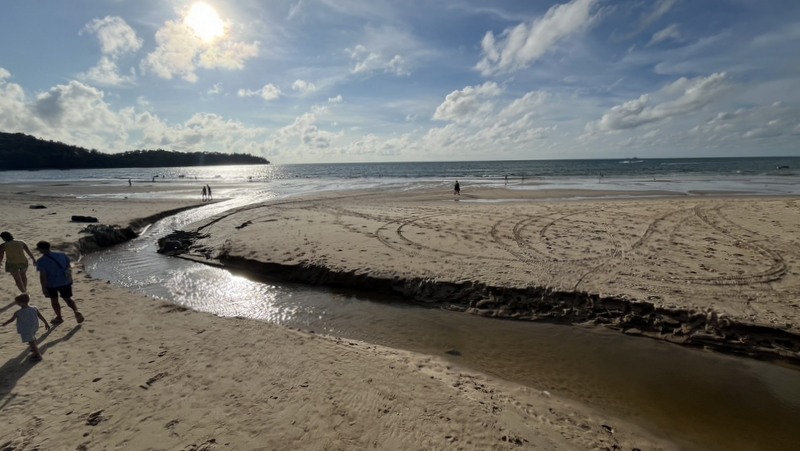




New wastewater treatment systems at Karon and Kamala were proudly touted as CWEG’s first priority ‒ two beaches that have long suffered from black, rancid wastewater flowing across the sand and into the sea where tourists swim.
The stinking runoff, which reappears after almost every rainy season, remains an annual embarrassment for Phuket’s tourism image ‒ and a recurring health risk for swimming in the water at key Phuket beaches. Yet despite signed agreements, planning and multiple site visits, no construction has begun.
According to Somkid Chokhong, Advisor to the Phuket Governor, the plan to have new wastewater treatment systems installed at key beach areas has fallen apart simply because the bureaucracy has failed.
Plans have yet to be finalised and approved, and funding still has yet to be approved, and the funding cannot be approved until the Terms of Reference are spelled out in detail.
“Some areas have not yet been able to outline the TOR. For example, the Cherng Talay is still in the process of outline, but there is still a lack of budget for construction,” Mr Somkid said.
“The Terms of Reference must be finalised before construction can begin,” Mr Somkid said plainly.
“Wastewater management is complex and expensive. We held a meeting last month to outline the TOR framework and identify responsible agencies,” he added.
Mr Somkid gave no other explanation as to why the entire project has been snarled up in red tape.
BANG TAO CAN WAIT
One key area expecting dire outcomes from poor wastewater treatment capability is Bang Tao, in Cherng Talay, where the ongoing construction boom has already seen the local population increase by more than 20,000.
Cherng Talay Tambon Administration Organisation (OrBorTor) Chief Manoch Panchalad was plain in his prediction in the ‘Bang Tao boom’ fallout.
“Overall, the Cherng Talay OrBorTor wastewater system is designed to serve more than 50,000 families across Cherng Talay, Bang Tao, Pasak and Khok Tanod,” he said.
“We do not have the facilities to treat wastewater from such a large population. There’s nothing we can do ‒ we simply do not have the budget.”
Years of planning and design work have stalled due to a lack of funding, despite Cherng Talay being one of the island’s most ready sites.
The Bang Tao wastewater system that currently exists was built using more than B300 million from local and environmental fund budgets. That system is now operating and has significantly reduced wastewater flowing into nearby canals and beaches, Mr Manoch said.
However, further expansion planned to serve communities in Pa Sak, Cherng Talay, and Khok Ta Nod has yet to begin.
“The designs and land are ready, but the project cannot move forward because there’s no budget,” Mr Manoch explained.
“We’ve submitted proposals through the province and are waiting for approval from the Office of Natural Resources and Environmental Policy and Planning (ONEP) under the Environmental Fund,” he said.
“I believe Bang Tao’s wastewater problems can be solved,” Mr Manoch said. “But the expansion will require hundreds of millions of baht and cannot start until new funding is approved.”
KARON STALL
In Karon, where black water has repeatedly stained the beachfront, the municipality has completed its system design and secured land for construction. However, the project remains at the funding stage, awaiting roughly B200mn from ONEP.
Somsak Rueanphae, Secretary to the Karon Mayor, said Karon Municipality has two projects under its current action plan. “The first involves fixing the existing wastewater treatment system, partly funded by the municipal budget,” he said.
“The second ‒ a new system planned for Kata along the Pak Bang Canal ‒ is under review to determine whether funding will come from the ONEP Fund or next year’s municipal budget. Karon still has significant unspent funds available.”
The first project, covering maintenance and upgrades to existing systems, has already begun.
The ST&BK Joint Venture was awarded the contract as the lowest bidder, offering to complete the project for B5,592,044.70, about 6.8% below the original budgeted amount. The contract was officially announced on Sept 27 this year.
“However, the second project, which involves installing a new treatment system by CWEG, has not yet started,” Mr Somsak added. “We already have a sufficient budget, but the TOR is still under review before we can proceed.”
KAMALA WOES
Kamala Beach continues to battle black wastewater discharges stretching up to 250 metres into the sea. Authorities have implemented short- and long-term measures while awaiting funding for a new treatment plant.
Kamala OrBorTor’s wastewater treatment system currently operates at only 30% of its 1,000-cubic-metre daily capacity as it is in dire need of repairs, said Kamala OrBorTor Deputy Chief Santhat Khummit.
Short-term remedial measures being rolled out include deploying ‘effective micro-organism balls (‘EM balls’), installing temporary pumps and closely monitoring wastewater discharge from hotels and businesses, he said.
As for the new CWEG system long-promised to come, Mr Santhat said, “The system design is complete, but a new site is needed due to narrow space at the existing facility.
“Previously, the pumping system was unbalanced because clean water from a mountain waterfall was mixed into the wastewater line,” he explained.
“Now, the Wastewater Management Authority (WMA) has built a water retention point near Kamala Police Station to pump wastewater directly from the source. This separates clean water from wastewater and has partially solved the problem.”
The WMA funded the project, which has eased some of Kamala’s long-standing wastewater issues ‒ but full treatment capacity remains far from sufficient, Mr Santhat noted.
Another critical area is the Sirinath National Park Canal, where black water continues to flow untreated into the sea.
“The WMA has allocated B40mn this year to build a wastewater treatment pond at Sirinath National Park,” Dr Somkid said. “The Sakhu OrBorTor has received approval from the Sangha Supreme Council to lease land from Wat Nai Yang for the project. Additional funds from the province (B2mn) and a private donation (B600,000) bring the total to B2.6mn.”
Once complete, the system will allow treated water to be reused for non-consumptive purposes, reducing discharge into coastal waters.
HELPING HAND
“The main problems with wastewater management are primarily at Kamala, Surin and Bang Tao,” Phuket MP Thitikan Thitipruethikul told The Phuket News.
“At Bang Tao Beach, the Environment committee and I conducted a site visit and worked with the Cherng Talay OrBorTor to monitor water quality. Following our observations, we coordinated the installation of water quality meters to track contaminants, chemicals and other impurities. According to the latest measurements, the water quality is currently within standard limits,” he explained.
“Cherng Talay OrBorTor is working with the Progressive Movement team from the People’s Party, which installed pH sensors that alert Cherng Talay OrBorTor if the water is abnormal,” he added.
“There have been no complaints filed regarding wastewater at this time,” he confirmed.
At Surin Beach, the main problem is the filtration system, which has problems during the rainy season, MP Thitikan noted.
“The solution, replacing the system, requires significant funding. As far as I know, this problem is already in the implementation plan. The project, designed by the CWEG, will require funding from the ONEP for implementation. I’m currently pushing for the Cherng Talay OrBorTor to address this issue,” he continued.
“Another area I oversee is Kamala. Kamala’s problem is frequent wastewater problems.
The wastewater problem stems from the existing wastewater treatment system, which has been in place for many years,” he said.
“However, the number of tourists and hotel rooms in Kamala has increased rapidly, the same as Bang Tao,” he noted.
“As the population has increased, the system has become overloaded. Meanwhile, installing an additional wastewater treatment system is facing budgetary and bureaucracy challenges.
“The previous governor pushed hard for this. The new governor will need to keep pushing this issue,” MP Thitikan told the Phuket News.
“We are currently in the low-season, so we need action on this. The problem will return when the tourism peak season arrives,” he concluded.