






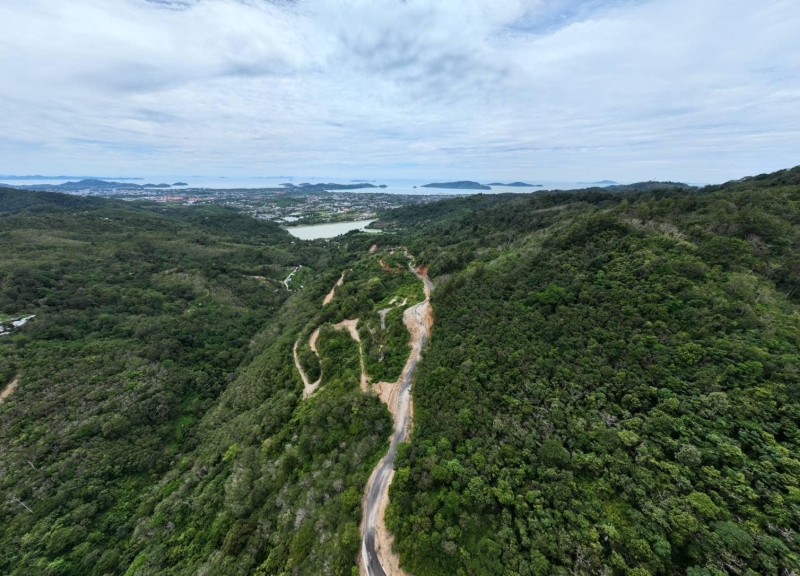


MP Chalermpong, MP for Phuket District 2, inspected the road, which he called “Luang Phu Supha Road” (as it continues behind the famed temple), yesterday (Sept 15).
The key issues are the issue of road damage and the cost-effectiveness of construction, Mr Chalermpong said in a post online.
The road was built under a budget “of tens of millions of baht” after Phuket Governor Narong Woonciew last October declared the landslide on Patong Hill a “disaster”, Mr Chalermpong explained.
Though no people were injured or killed in the landslide, declaring the incident a “disaster” allowed access to the provincial disaster relief fund to pay for road improvements to alleviate the impact on essential traffic travelling to and from Patong, Phuket’s main tourism town.
The inspection revealed that the road condition was “seriously damaged” and “hardly usable”, Mr Chalermpong noted.
On the left side large tufts of vetiver grass was growing, on the right side some areas showed signs of slides.
The road surface was only about two to three centimetres thick, Mr Chalermpong said.
“For this I will be submitting a question to Parliament to find a conclusion as quickly as possible,” Mr Chalermpong said.
FAST MOVES
Work on creating the new road began less than a week after the landslide on Patong Hill on Oct 19 last year.
Less than four months later, although the road remained crushed rock, it was already in use by people by early March this year.
Tiwat Seedokbuab, Deputy President of Phuket Provincial Administration Organisation (PPAO), himself expressed concern for safety of people using the road, as several sections over the hills were very steep, and still just dirt.
The PPAO aimed to have the dirt sections of road covered with concrete, but faced budget issues and needed permission from the Phuket Provincial Forestry Office to have one section of road paved with asphalt, he said.
“In case of rain, the slopes can be dangerous for drivers. Our engineers have already measured how long and wide sections of road with steep slopes will be turned into concrete roads and they are designing it. We chose concrete because it is durable from water erosion during the rainy season,” he said.
“Chalong Municipality and Patong Municipality will both have to file their requests to the PPAO for the budget to improve the steep sections of road in their areas. We have had a meeting about this already and we will look into how much each of them can support the construction cost and how much the PPAO will support the budget,” he added.
However, there has been no progress in making the road safer since March.
Mr Tiwat noted that the road not only serves as an alternative route to and from Patong, but is also an attraction for tourists in itself.
“Apart from being an alternative route, the road also has the potential to be a new attraction for tourism because of its scenery,” he said.
“A lot of people are using this route during the day now, and we can see that many tourists are interested in this route because of its beautiful view and fresh breeze.
“There are also plenty of runners exercising around the area,” he said.
How much the project would cost in total to build the fully fledged road, and how much the road has cost so far, have never been revealed.
Mr Tiwat in March declined to give a figure for the construction costs for the road.
“We are still finalising it,” he said.