






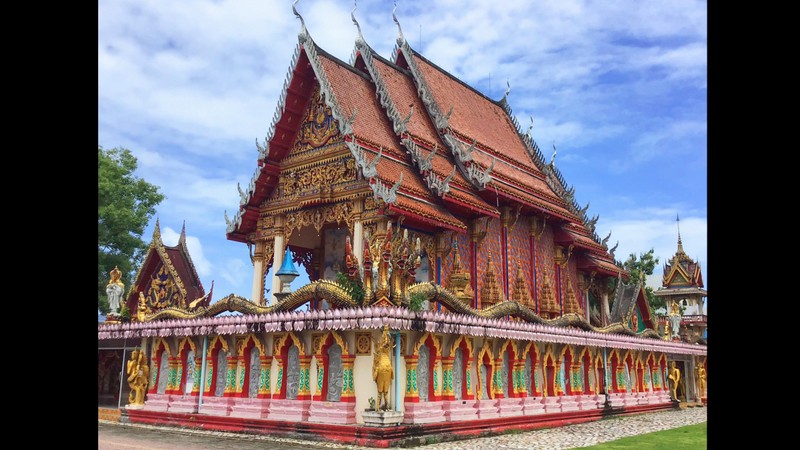


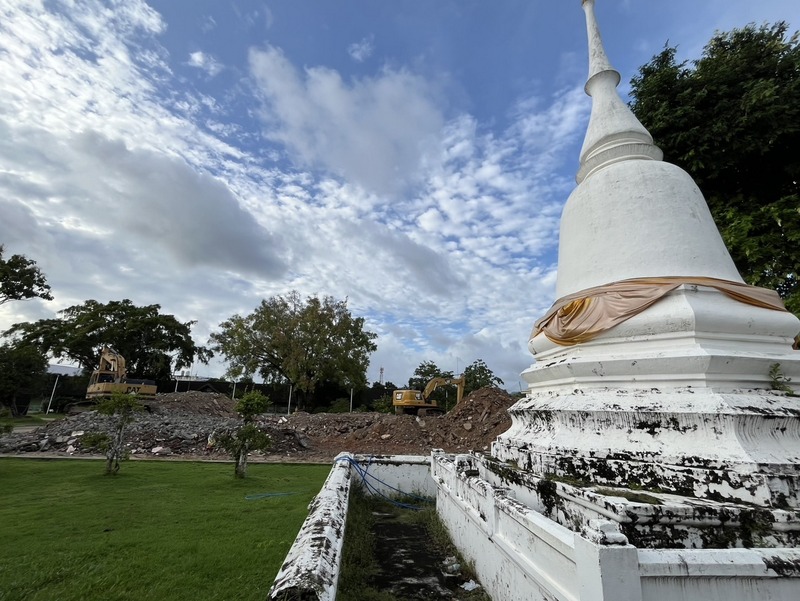


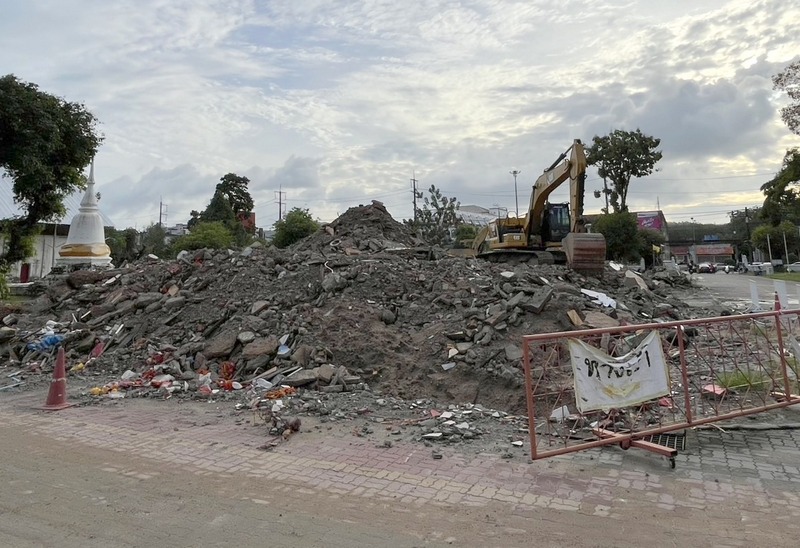


The hall, known as the Ubosot, was the site of major ceremonies and rituals. “This temple is a symbol of Thalang, revered by the people… It’s strange how it was allowed to be demolished,” said one resident. “How could they demolish it? Why?” asked another. “It stood for many years, and they demolished it in just a few days.”
Many lamented the loss of the interior murals, which depicted local history and legends. “The paintings inside were very informative, so beautiful. What a shame they are gone,” said another local.
SAFETY CONCERNS
According to the Phuket Provincial Public Works and Town & Country Planning Office (DPT), the Ubosot was in dangerous disrepair. A notice posted at the temple explained that an inspection on July 15 found severe structural deterioration, including cracks and leaks that made restoration unsafe.
“The structures show clear signs of deterioration, including cracks and leaks, which make them difficult to restore to a safe and complete condition,” the notice read. Continued use was deemed a risk to occupants, and demolition was recommended.
The notice added that the abbot is working with the Fine Arts Department to finalise design documents for a new hall.
‘SURPRISE’
Even the Phuket branch of the National Office of Buddhism (NOB) was unaware of the demolition before it happened. “Wat Phra Nang Sang was demolished at the beginning of September without notice,” said NOB Phuket Chief Wasan Sangsin.
“The abbot ordered the demolition, stressing the building had become structurally unsafe and that he acted fully within his authority under Thai law and Buddhist Sangha regulations.
“The temple is a juristic person, and the abbot is its representative. He has legal authority over management, including repairs or, if necessary, demolition of unsafe buildings,” Mr Wasan explained. “Repair was not possible because the structure had already collapsed internally.”
Mr Wasan clarified that the NOB does not directly punish monks. “When an abbot violates rules, the NOB refers the matter to a senior monk and committee, who decide on disciplinary measures. But in this case, the abbot followed the proper procedures.”
Repeated attempts by The Phuket News to contact the abbot were unsuccessful.
Mr Wasan said his office later learned that the Ubosot, last renovated nearly 40 years ago, was built with pillars left exposed for several years before completion. Steel reinforcements inside the pillars rusted over time, expanding and causing cracks throughout the structure. “Water leaked into the hall during the rainy season, and the Phuket DPT confirmed it could collapse at any time,” he said.
“If the structure collapsed on its own, crushing people, the abbot and community leaders would be held responsible,” he added. The abbot presented the DPT’s findings to community leaders and the temple committee before demolition, and “no one objected because it was a matter of life and death”.
NATIONAL HERITAGE
The temple is recognised and registered by the Fine Arts Department as an ‘ancient site’. The original Ubosot at Wat Phra Nang Sang dates back to the early Rattanakosin period and has undergone several restorations over the centuries.
The temple was recognised for historical and cultural value, and the site was officially registered as an ancient monument on Mar 1, 1984.
Wat Phra Nang Sang was built around 1767 and was granted royal permission for the construction of boundary markers. The protected area covers 3 rai, 2 ngan, and 8.63 square wah (about 5,634 square metres).
Inside the Ubosot were four significant stucco Buddha images: one in the reclining posture and three in the Mara-Vijaya posture, crafted by local artisans. The works were classified as examples of Rattanakosin art.
The temple remains deeply tied to the history of Thalang. According to local lore, Phra Nang was the wife of a nobleman in Langkawi. She was falsely accused of having an affair with a royal page, and was therefore executed.
Before her execution, she requested to pay homage to the sacred relics of Sri Lanka, stopping in Thalang.
According to legend, when she was executed, the blood that flowed out was white instead of red, surprising and leading to the belief that she was innocent, hence the name ‘Phra Nang Lueat Khao’ (the White-Blooded Lady).
The temple was named ‘Wat Phra Nang Sang’ as it marks the place where her life came to an end, giving rise to the legend.
Wat Phra Nang Sang was once the site of a gathering camp for Phuket’s famed Heroines ‒ Thao Thep Krasattri and Thao Sri Soonthorn ‒ in the fight against Burmese marauders during the battle of Thalang in 1785. As history notes, the battle was successful, driving out the raiders and securing Thalang.
Inside the Ubosot ‒ which is now demolished ‒ were three of the world’s largest ancient tin Buddha images, known as ‘Phra Nai Phung’ or ‘Phra Sam Kasat’. The murals on the interior walls depicted the heroic deeds of Thao Thep Krasattri and Thao Sri Soonthorn.
In addition to its spiritual role, the temple has long supported education by providing land and facilities for the establishment of a primary school, developed in cooperation with both government and private agencies.
PLANS TO REBUILD
Mr Wasan confirmed that the abbot has pledged to construct a new Ubosot on the same site. All sacred items inside the demolished hall, including Buddha statues and sculptures, are being carefully relocated under the supervision of engineers. The murals, however, are lost.
Chalermwut Phimphiyut, Director of the Ancient Monument Conservation Group at the Fine Arts Department’s Region 12 office in Nakhon Sri Thammarat, confirmed that approval has been granted for a new Ubosot. “We have already discussed and reviewed the issue,” he said. “We acknowledge the concerns from the abbot and have granted permission for the temple to rebuild.”
However, Mr Chalermwut declined to confirm whether his office gave prior permission for the old Ubosot’s destruction.
Under Thai law, anyone wishing to repair, alter, demolish or excavate within a registered ancient site must obtain written permission from the Fine Arts Department. Failure to do so carries penalties of up to seven years in prison, a fine of up to B700,000, or both. For registered monuments, penalties increase to 10 years and B1 million.
The approval process requires a site inspection, committee evaluation and final sign-off by the department’s Director-General, typically taking 22 business days. Applicants must submit ID documents, site plans, proof of land ownership and other supporting papers.
“For Wat Phra Nang Sang, the Fine Arts Department has already approved the reconstruction,” Mr Chalermwut said, noting that records show the last major renovation of the Ubosot in 1917, though the NOB Phuket office maintains it was last renovated about 40 years ago. Minor repairs such as repainting do not require departmental approval.
While residents mourn the loss of the centuries-old hall and its priceless murals, officials stress that public safety had to come first. “If the structure collapsed, people would be injured or killed, and the abbot would bear responsibility,” Mr Wasan reiterated.
Despite the controversy, the Fine Arts Department’s approval means the temple can proceed with rebuilding. The abbot has not announced a construction timeline, but the new Ubosot is expected to preserve as much of the temple’s historic character as possible while meeting modern safety standards.
For many in Thalang, the sudden demolition has left deep scars. “It’s not just a building,” said one long-time resident. “It was part of our history and our hearts. We can build again, but we can never bring back what was lost.”