






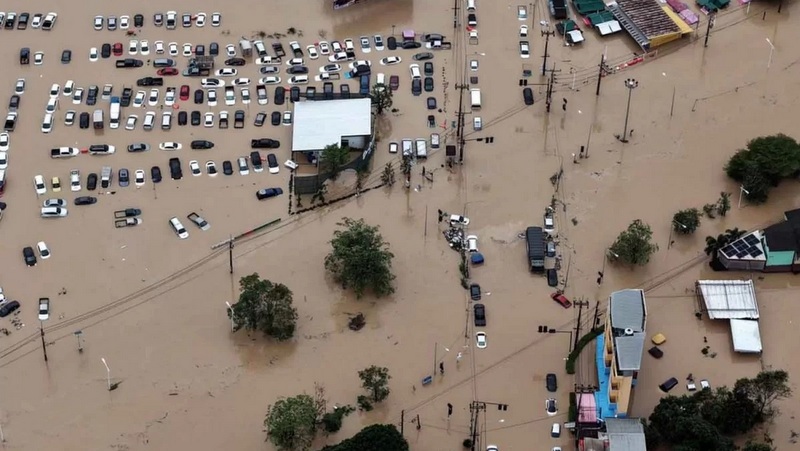
Assoc Prof Seree Supratid, director of the Climate Change and Disaster Centre at Rangsit University and vice president of the National Disaster Warning Council Foundation, said yesterday (Nov 25) that despite falling water levels upstream in Sadao district, downstream flows will increase before reaching the city, exacerbating the flooding.
“At 7am [on Tuesday], floodwaters had risen nearly two metres compared to [Monday]. Homes previously submerged by one metre are now completely underwater, while low-lying houses in areas such as Khuan Lang Municipality are submerged up to their rooftops,” he said in a Facebook post.
He estimated that rainfall between Nov 21–25 reached about 850 millimetres, generating 1,200–1,500 million cubic metres of runoff, reports the Bangkok Post. With natural drainage and pumping capacity, it could take roughly 10 days for water to recede, further delayed by high sea levels expected until the end of November.
Assoc Prof Seree criticised the lack of coordinated disaster management under the Disaster Prevention and Mitigation Act of 2007, noting that while the situation has been raised to Level 3 with the interior minister as incident commander, government action has relied on Cabinet regulations rather than formal mechanisms.
“People are stranded on rooftops, vehicles are submerged, and vulnerable groups are pleading for help, yet there is no central command structure,” he said.
He urged immediate measures such as cutting road embankments to accelerate drainage and minimise losses.
Maitree Jongkraichak, manager of the Thai Community Foundation, called for urgent interventions.
Via social media, he proposed forming an expert “war room” including academics, community networks, and data analysts, and deploying national and provincial disaster plans.
Recommended actions include mapping flood risks, coordinating rescue operations via a central radio hub, mobilising boats and military aircraft for transport, establishing evacuation centres and central kitchens, and providing timely press updates every two hours.
Marine ecology expert Thon Thamrongnawasawat emphasised the broader lessons from Hat Yai, highlighting that disasters in the era of global warming are intensifying.
He advised residents to “not become victims” by preparing emergency supplies, planning escape routes, and assisting vulnerable individuals early.
Airports in South skirt flooding woes
Meanwhile, all airports in the South remain operational despite widespread flooding, but six state-run bus routes have been suspended, while in Hat Yai district of Songkhla province, about 1,000 Malaysian and Singaporean tourists are still awaiting evacuation from their hotels.
The Civil Aviation Authority of Thailand (CAAT) said yesterday (Nov 25) it is closely coordinating with airlines, airports and air traffic authorities to keep operations safe and minimise any disruption to passengers, reports the Bangkok Post.
Although Hat Yai airport continues to operate normally and all scheduled flights are running, floodwater around the terminal has made travel into and out of the airport difficult, said the CAAT, adding it has also instructed airlines to implement urgent passenger-support measures, including flexible rebooking, route changes and refunds.
These airlines, namely Thai Airways, Bangkok Airways, Thai VietJet, Thai Lion Air, Thai AirAsia and Nok Air have also been supplying drinking water and food to stranded passengers and airport staff, said the CAAT.
Flight sequencing, cargo handling and storage are being jointly managed to speed up relief efforts.
Meanwhile, passengers who cannot reach Hat Yai have begun shifting to nearby airports such as Narathiwat and Krabi, both of which have seen increased passenger flows but remain within operational capacity, according to the CAAT.
The Department of Airports (DoA) insisted that all airports under its jurisdiction in the southern zone - including Hua Hin, Chumphon, Surat Thani, Krabi, Nakhon Si Thammarat, Trang, Ranong and Betong - are operating normally with no weather-related delays.
Narathiwat airport, for instance, remains open despite standing water in parts of the airfield, which authorities said remains within safety limits, said the DoA, adding that one access route to the airport is open, and additional pumps have been installed to drain water from the taxiway area.
State-run Transport Co announced the temporary suspension of six southern bus routes starting from yesterday, citing impassable roads and safety concerns.
The suspended routes include Bangkok–Trang–Satun, Bangkok–Yala, Bangkok–Satun, and Bangkok–Hat Yai.