






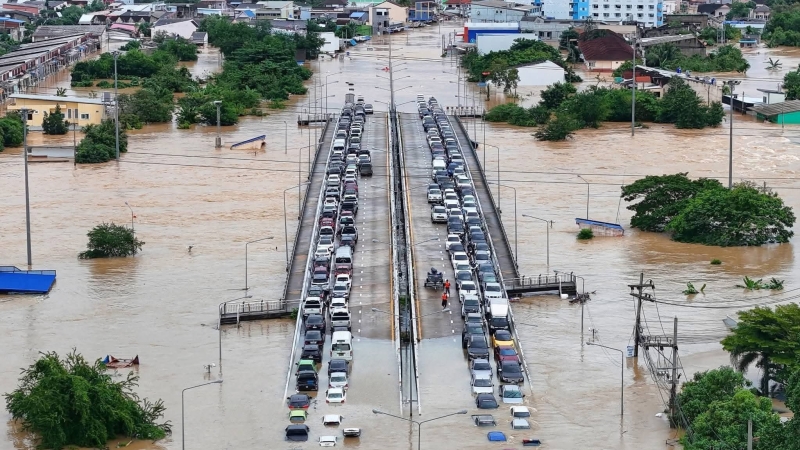
Kasikorn Research Center (K-Research) reports that the losses would result from disruptions of economic activities in the service sector, including hotels, restaurants, retail and transport, as well as in agricultural and food processing industries, reports the Bangkok Post.
Thanavath Phonvichai, president of the University of the Thai Chamber of Commerce, estimates a loss of B1-1.5bn per day due to flooding in economic and tourism areas across 10 southern provinces. If the floods persist for a month, he said the loss will reach B10-15bn.
Songpon Changsirivathanathamrong, president of the Songkhla Chamber of Commerce, said flooding in Hat Yai district affected 80-90% of the area. The district’s business sector is reliant on retail and wholesale trade, tourism, hotels and restaurants.
Songkhla has a total GDP of about B250bn, with Hat Yai accounting for 40-50%, he said.
Most factories are located in Sadao and Singha Nakhon districts, along with some parts of Mueang district, where operations continue without reported machinery damage.
Salil Tohtubtiang, vice-chairman of the Thai chamber and chair of the Southern Regional Chamber of Commerce, said it is difficult to assess the economic damage from the floods because they are spreading beyond Hat Yai and Songkhla to Phatthalung, Satun, Nakhon Sri Thammarat, Pattani and Yala.
The economic impact spans all sectors including agriculture, services, hotels and manufacturing. Some factories have suspended operations because workers cannot travel, and raw materials cannot be transported to factories.
RELIEF MEASURES
Thaniwan Kulmongkol, president of the Thai Restaurant Association, said many restaurants in the South, especially in the city centre of Hat Yai, are submerged. Restoration is anticipated to take months, she said.
The flooding is occurring during the tourism high season, which could decrease confidence among travellers, taking time to regain their trust, said Mrs Thaniwan.
Kamol Meechaipattanakit, a member of the southern subcommittee of the Restaurant and Goods Product Association, told the Bangkok Post floods have severely affected its members as many are unable to operate their businesses.
He said the news has deterred some travellers from visiting southern Thailand, affecting destinations that are not inundated as consumers are hesitant to dine out.
Mr Kamol said the government must launch a relief package for both the public and business operators because their recovery is interconnected.
"The government should introduce soft loans for restaurant operators with relaxed terms, making them accessible for everyone," he said.
Mr Kamol urged the banking regulator and commercial banks to ease borrowing conditions for those affected by this disaster.
Mr Songpon said the immediate priority is to provide food to people stranded in flooded areas, utilising organised communication and resource allocation to enhance efficiency and mitigate redundancy.
Mr Salil said the restoration measures must include efficient management of waste and mud, which will be difficult to remove once dried. Authorities should also decide about special loans for property repair or debt payment extensions, he said.
In the long term, a comprehensive plan is needed as flooding is likely to happen again and relocating residents from these areas would be extremely challenging, said Mr Salil.
Commerce Minister Suphajee Suthumpun said the Department of Internal Trade (DIT) rolled out four urgent measures to assist flood victims.
The DIT is coordinating with shelters to ensure adequate cooking supplies, and reached out to modern trade operators and the Layer Farmers Association to supply consumer goods to areas in need and experiencing transport obstacles.
The department is preparing to distribute survival kits to victims in areas where floodwaters are receding, aiming for a swift recovery. Another tactic is organising Blue Flag events, offering essential items at discounted prices to help reduce living costs.