






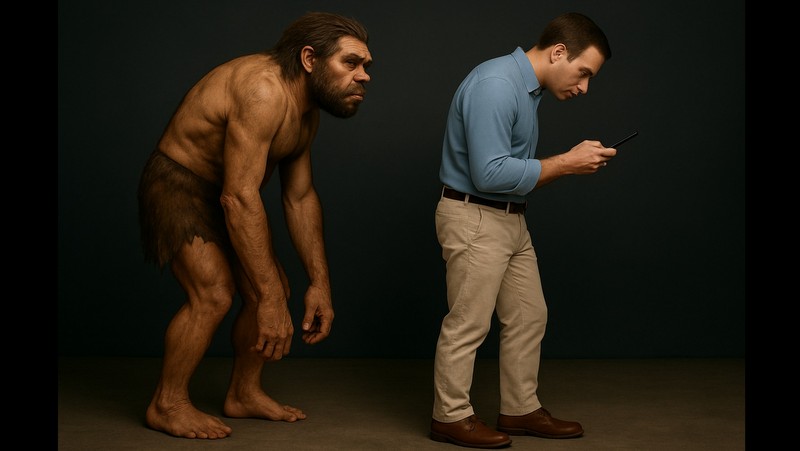
Evolution, it seems, has taken a U-turn. Poor posture is the silent saboteur of modern life. Shoulders round forward, the chest collapses and the head juts out like a turtle peeking from its shell. The spine’s graceful S-curve contorts into a weary question mark. What was once an expression of confidence and vitality has become a default slump – molded by endless screen time, soft chairs, and sedentary habits. Slouching does not just look lazy; it quietly drains energy, compresses circulation, and starves your body of vitality at a cellular level.
When you slouch, the chest cavity collapses, and the diaphragm loses its full range of motion. Each breath brings in less air, and the lower lobes of the lungs – where oxygen exchange is richest – never fully expand. The result is a subtle but chronic state of low oxygen, known as hypo-oxygenation. When oxygen levels drop, the tiny capillaries that deliver oxygen to your tissues start to suffer. These vessels rely on a steady oxygen gradient to move oxygen from the bloodstream into the cells. When that gradient weakens, diffusion slows, and tissues are literally starved of fuel.
Inefficient
Over time, low oxygen triggers vasoconstriction, the narrowing of small vessels, and something called endothelial dysfunction – the stiffening of the delicate lining inside your capillaries. Once that happens, circulation becomes sluggish, nutrient delivery falters and waste removal slows. The result is a perfect storm of micro-inflammation, stiffness and reduced tissue repair. In short, chronic low oxygen makes your capillaries sluggish, leaky and inefficient – setting off a chain reaction that limits healing, weakens muscles and leaves connective tissue tight and undernourished. Poor posture also compresses blood vessels in the pelvis and legs, contributing to swelling, varicose veins, and in the long run, an increased risk of cardiovascular problems.
Slouching also wreaks havoc on muscle balance. When your torso collapses, your core muscles – the deep stabilizers of the spine including the abdominals, obliques, and glutes – switch off. That leaves your lower back to carry the load. It is why so many desk workers complain of chronic back pain. Their spines are not weak – their abdominal muscles and glutes have simply taken early retirement, forcing the lumbar muscles into overtime.
Too much sitting creates its own vicious cycle. When you sit, your hips and knees stay bent, which keeps your hamstrings – the long muscles at the back of your thighs – in a shortened position. Sit like that for hours every day and your body adapts: muscle fibers and fascia literally “forget” how to extend fully. The shortened hamstrings pull on the pelvis, tipping it backward and flattening the natural curve of the lower spine. Over time, that distortion contributes to tight lower backs, stiff hips, and – you guessed it – poor posture.
And it does not stop at the body. Posture shapes psychology. Studies show that slouching is associated with lower energy, dampened mood and even increased stress reactivity, while upright posture boosts confidence, alertness and emotional resilience. In other words, standing tall does not just make you look more confident; it actually helps you feel that way. Proper alignment is not vanity – it is psychological armour.
Adaptable
The good news is that poor posture can be reversed. The body is remarkably adaptable. Consistent movement, mindful awareness and a few simple adjustments can undo years of slouching. Standing up and stretching every thirty minutes reawakens circulation and reminds the body what vertical feels like. Strengthening the core – not just the abdominals but the whole system of muscles that stabilises the spine – gives the body its scaffolding back. Planks, bridges and gentle Pilates movements reactivate those sleepy stabilizers and bring balance back to the torso.
Releasing the front of the body and reawakening the back is equally essential. Opening tight chest and hip muscles allows the spine to return to its natural curve, while strengthening the upper back helps the shoulders pull gently into alignment. Think of it as retraining your body to “un-slouch.”
Even the way you breathe matters: deep, diaphragmatic breathing restores oxygen flow, calms the nervous system and strengthens the inner corset of muscles that support your spine. Each full inhale expands and lifts; each complete exhale stabilises and grounds. You can literally rebuild your posture from the inside out – one breath at a time.
Finally, environment matters. Adjust your workspace so your monitor sits at eye level, your feet are flat, and your pelvis is neutral. Imagine a string attached to the crown of your head, gently lifting you upward — a simple cue that lengthens the spine and awakens postural awareness. And if you want an instant test of strength, try sitting on a backless stool. It forces your body to rely on its own internal support instead of the chair’s.
With consistency and awareness, you can undo years of slouching. Stand tall, breathe deeply and remind gravity who is really in charge. The next time you catch yourself hunched over your device, straighten up. Pull your shoulders back, engage your core and take a big, juicy breath. Imagine you are not evolving backwards, but forwards – into a future where technology and human health productively coexist.
Libby Heath recently became the first Mayo Clinic certified wellness coach in Asia. She shares her insights and advice through her column ‘Wellthwise’ here in The Phuket News. Please note that if you have a condition that requires medical treatment, consult your doctor. Contact Libby at: BeWellthwise@gmail.com.