






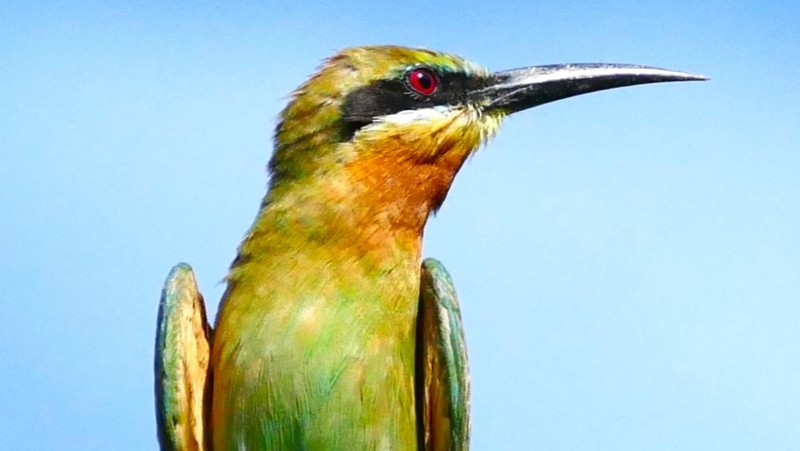


These birds are pretty common and can be seen all over the island. They vary in size from that of a Robin to the that of a Starling, Mynar Bird, while in other countries and areas there are bigger ones up to 30 centimetres long. But here on Phuket the five main ones are smaller. To see these you do not need to go far as you will find them from the edges of the towns right into the jungle areas and anywhere you find trees and water. The good thing is none of them are under threat despite suffering from habitat loss, their eggs being eaten by snakes and rodents and the adults occasionally being taken by larger prey.
Bee Eaters have 31 species with most found in Africa and Asia and a scattering in southern Europe, Australia and New Guinea. In Phuket there are five different types of stunning colour which can be seen all year round. They are easy to spot as not only are they brightly coloured but also many types live in colonies. So, where there is one, you will always find more.
They nest in burrows in sandy cliff faces or any vertical face where they can tunnel. They have downward curving bills and, as the name suggests, they hunt bees, wasps and flying insects. You see them catching things in mid-air and before taking them to a perch where they bash them to remove any stings or poisons before eating them.
First we have the Blue Tailed Bee Eater. This, I will say, is the most common here on Phuket, a richly coloured, slender bird. Predominantly green, its face has a narrow blue patch with a black eye stripe and a yellow and brown throat, while the tail is blue and the beak is black. The three outer toes are united around their bases. It can reach a length of 23-26cm, including the two elongated central tail feathers which can be just two inches more than the remaining ten feathers. Sexes look the same and is usually found near water.
Elongated
Then there is the Green Bee Eater, otherwise known as Asian Green or Small Green Bee Eater. Even though it is supposed to be quite common I have not see this one myself yet. Like other Bee Eaters, this species is a richly coloured, slender bird. It is about 23cm in length with about 2 inches of that made up by the elongated central tail feathers. The sexes are not visually distinguishable. The entire plumage is bright green and tinged with blue, especially on the chin and throat, while the crown and upper back are tinged with gold and a fine black line runs in front of and behind the eye. The iris is crimson and the bill is black while the legs are dark grey. Southeast Asian birds have a reddish brown crown and face with green underparts. The wings are green and the beak is black. The elongated tail feathers are absent in juveniles. Sexes are alike.
My favourite is the much smaller Chestnut Headed Bee Eater, which at 18–20cm in overall length, is noticeably smaller. For me they appear more shy and although they don’t fly away they also do not venture so close. Both sexes again are similar in appearance. The head and neck are bright chestnut with a black thin band under the eye and ear-coverts. The breast and lower back are bright green and the rump and under the tail are pale shining blue. The top of the tail is green and tipped dusky, the sides of the face, chin and throat yellow. The remainder of lower plumage is green tipped with blue, which makes for a very colourful bird. However, what makes it stand out is the chestnut head which almost seems to glow in the sunlight.
Rich variety
The Blue Throated Bee Eater is found through out Southeast Asia in subtropical or mangrove forests. With a diet consisting of mostly bees, wasps and dragonflies they like to be near water. They are small with colourful plumage consisting of a reddish brown head, dark green wings and breast, with their signature blue throat. Juvenile plumage contains dark green head and wings and light green breasts, only developing their full plumage in adulthood. They have a rich variety of calls which allow them to communicate long distances in the forest. I am sorry to say I have not see these yet either.
Last but not least is the Blue Bearded Bee Eater. This is a rare visitor to Phuket and not seen in large numbers but is a regular sighting. The name comes from the loose fluffy feathers under the chin. This is probably the largest species of the Bee Eater family, with adults measuring between 31-35cm. This species has a large sickle shaped bill and the square ended tail lacks the long central feathers that are typical of smaller species. The bird is grass green with a turquoise forehead, face and chin and the feathers of the throat are elongated, giving it a bearded appearance when they are fluffed out. The belly is yellowish to olive with streaks of green or blue. There is a slight difference between the male and females as in the blue beard feather in the male have a slight ultra violet sheen to them. Again they nest in burrows in sandy banks and feed mostly on bees and other flying insects.
I am sure anyone interested in birds, wildlife and nature photography will have seen at least one type of Bee Eater while out and about, even if they were unsure of what type it was. You can spend a fair bit of time watching them hunting and going in and out the burrows to feed the young. This year I have seen a noticeable increase in both the Chestnut Headed and Blue Tailed ones around the hills between Patong and Karon Beaches in the areas of Tri Trang, Freedom beach and Paradise beach. These areas are always a nice area to take a walk on a lazy afternoon as you also get stunning sunsets, views and a nice cool breeze too which also makes it a good place to see raptors using the sea breeze to gain height.